
News
Forbes: Rioja Is More Than Tempranillo (and the Trade Should Take Note)
Forbes has once again turned its editorial focus to Rioja, this time underscoring a critical point for the global wine trade: Rioja has never been a single-variety region, and producers are now making that message explicit.

In “Rioja Is More Than Tempranillo Now—And Winemakers Want You To Know It,” Forbes contributor Emily Price presents a detailed, producer-driven examination of Rioja’s long-established but often under-communicated varietal diversity.
The article draws directly from leading Rioja wineries to reinforce that Garnacha, Graciano, Mazuelo, and other indigenous grapes are not novelties or experiments—they are structural components of Rioja’s identity, history, and future market positioning.
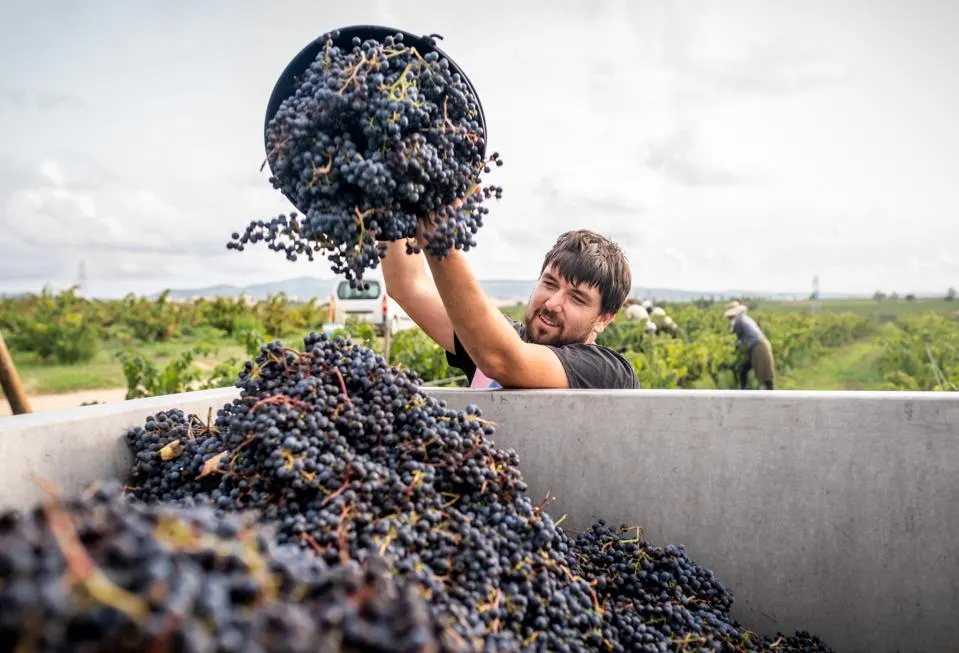
Forbes Reframes Rioja’s Narrative for a Global Audience
As Forbes notes, Tempranillo has functioned as a global reference point for Rioja—reliable, age-worthy, and familiar. However, the article makes clear that this reputation has also simplified the region’s story.
Price explicitly states that Rioja “has never been a one-grape region, even if that is how it has often been marketed.” The article positions today’s renewed focus on Garnacha, Graciano, and Mazuelo not as a trend cycle, but as a recalibration—bringing long-standing varieties back into clearer view for international markets.
This reframing matters for buyers and sommeliers working in increasingly competitive category sets, where differentiation and authenticity drive placement decisions.
Producer Voices: Continuity, Not Reinvention
The Forbes article relies heavily on direct commentary from producers, reinforcing credibility and trade relevance.
At Bodegas Manzanos, CEO Víctor Manzanos emphasizes continuity rather than disruption:
- Tempranillo remains foundational for structure, balance, and aging potential.
- Garnacha, Graciano, and Mazuelo have always contributed complexity and regional identity.
- Garnacha, in particular, has been a strategic focus for over a decade—not a reactive shift.
Forbes highlights Manzanos’ single-vineyard Garnacha bottlings and long-standing Graciano holdings as evidence that Rioja’s varietal depth is already established at the production level, even if underrepresented in global perception.
Graciano and Mazuelo: Structural Assets, Not Blending Afterthoughts
One of the article’s strongest trade takeaways is the repositioning of Graciano and Mazuelo as intentional structural tools, not secondary grapes.
Forbes notes that Manzanos controls one of the largest and oldest Graciano vineyard holdings in Rioja, using the variety for wines built around longevity, acidity, and aromatic intensity. These attributes are increasingly relevant in modern wine programs prioritizing balance and ageability without excess alcohol.
Mazuelo, while less frequently bottled alone, is framed as a critical contributor to freshness, tannin structure, and savory tension—particularly valuable in warmer vintages and evolving climatic conditions.
Campo Viejo: Institutional Validation of Varietal Diversity
The article reinforces Rioja’s internal consistency by featuring Campo Viejo, where chief winemaker Ignacio López positions today’s interest in non-Tempranillo varieties as business-as-usual rather than a revival project.
Forbes documents that:
- Garnacha, Graciano, and Mazuelo have been part of Campo Viejo wines since the winery’s founding.
- These grapes remain integral to both blends and single-varietal releases.
- Campo Viejo’s Reserva—often cited as a reference Rioja—still relies on this traditional multi-variety framework.
For the trade, this signals that Rioja’s diversity is not limited to boutique or niche producers—it is embedded across volume, premium, and global distribution tiers.
Market Alignment and Climate Context
Forbes also situates Rioja’s varietal breadth within current market and climatic realities.
According to the article:
- Garnacha’s heat tolerance and generosity align well with warmer growing seasons.
- Graciano’s late ripening supports freshness and structure under changing conditions.
- Modern vineyard management and irrigation allow producers to maintain precision and consistency.
From a commercial standpoint, Forbes positions Rioja’s indigenous varieties as assets, not risk factors—capable of delivering both single-varietal interest and blended reliability.
Key Trade Implication: Rioja’s Portfolio Is Broader Than Its Reputation
The central message of the Forbes article is unambiguous: Rioja’s future competitiveness lies in communicating what has always existed.
Rather than abandoning Tempranillo, Rioja producers are clarifying how Garnacha, Graciano, Mazuelo, and other native varieties:
- Expand stylistic range
- Support climate adaptability
- Strengthen blending options
- Enable clearer segmentation across channels and markets
For trade professionals, Forbes’ continued coverage reinforces Rioja’s positioning as a region of depth, flexibility, and institutional credibility, capable of meeting both traditional and contemporary program needs.